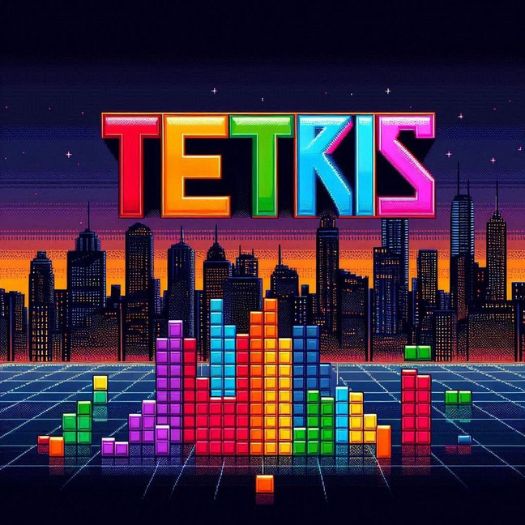
falconcreationsindia.com – Tetris is one of the most iconic and influential video games in history. Known for its simple yet addictive gameplay, Tetris has transcended generations, platforms, and cultures. Since its creation in the 1980s, the game has become a global phenomenon and remains popular to this day.
The Birth of Tetris
Tetris was created in 1984 by Alexey Pajitnov, a Soviet computer scientist working at the Dorodnitsyn Computing Centre of the Soviet Academy of Sciences in Moscow. Pajitnov developed the game as a personal project inspired by a traditional puzzle game called pentominoes, which involved fitting geometric shapes together.
The name “Tetris” comes from the Greek word “tetra,” meaning four, referring to the four-block shapes known as tetrominoes, combined with Pajitnov’s love for tennis. The original version of Tetris was programmed on an Electronika 60 computer, which had no graphics, so the blocks were displayed using text characters.
Rapid Spread and Early Popularity
Tetris quickly gained popularity among Pajitnov’s colleagues and began spreading across the Soviet Union through floppy disks. Eventually, the game reached Eastern Europe and then Western countries, where software companies recognized its massive potential.
During this time, the rights to Tetris became complicated due to Soviet laws that prohibited private ownership of software. Several companies believed they had secured the rights, leading to legal disputes that lasted for years.
Tetris and Nintendo’s Breakthrough
The turning point in Tetris history came in 1989, when Nintendo released Tetris on the Game Boy. Nintendo marketed the game not just to children, but also to adults, presenting it as a game anyone could enjoy. This decision proved revolutionary.
Tetris became the main reason many people bought the Game Boy, helping the handheld console achieve enormous global success. The simple gameplay, combined with endless replay value, made Tetris the perfect portable game.
Gameplay That Changed Gaming
The core mechanics of Tetris are deceptively simple: players rotate and position falling tetrominoes to complete horizontal lines. When a line is completed, it disappears, creating space for more blocks. As the game progresses, the speed increases, testing the player’s reflexes and strategic thinking.
Despite having no storyline or characters, Tetris engages players through rhythm, pattern recognition, and problem-solving. This design influenced countless puzzle games and proved that games did not need complex graphics to be successful.
Legal Battles and Ownership
For many years, the rights to Tetris were controlled by the Soviet government. In the 1990s, after the fall of the Soviet Union, The Tetris Company was established by Alexey Pajitnov and Henk Rogers. This company now manages the Tetris brand and licenses it to developers worldwide.
The resolution of these legal issues allowed Tetris to expand further across home consoles, arcades, PCs, and later mobile devices.
Tetris in the Modern Era
Today, Tetris is available on nearly every platform, including smartphones, consoles, and virtual reality systems. Modern versions such as Tetris Effect have introduced stunning visuals and music while preserving the classic gameplay.
Tetris has also been studied scientifically. Researchers have found that playing Tetris can improve spatial reasoning and may even help reduce symptoms of stress and trauma, a phenomenon often referred to as the “Tetris Effect.”
A Lasting Legacy
With hundreds of millions of copies sold, Tetris is one of the best-selling video games of all time. Its universal appeal lies in its simplicity, accessibility, and timeless design.
More than four decades after its creation, Tetris remains a symbol of how a simple idea can change the gaming industry forever. It is not just a game, but a cultural icon that continues to shape the world of video games.
About the Author